History of the
CONTEMPORARY SCULPTURE
MORE THAN A CENTURY OF ARTISTIC REVOLUTIONS
The Great Gates of Sculpture History
Auguste Rodin – The one who restored sculpture to man (1840–1917)

Auguste Rodin in his studio. With him, sculpture ceased to celebrate only heroes to reveal the full humanity of its subjects.
Question : Who deserves to be sculpted?
For more than two thousand years, Western sculpture has pursued the same ideal: to represent what deserves to be immortalized.
The gods first.
Then the emperors.
The kings.
The saints.
The heroes.
Sculpture celebrates those whom history deems worthy of enduring through the ages. Even when it depicts an ordinary man, it transforms him into a model. His body becomes more noble, his posture more perfect, his expression more refined. The work speaks less of the human being than of the ideal he embodies.
Then Auguste Rodin asked a question that almost no one had really asked before him.
What if the true subject of sculpture was no longer the hero, but man?
This seemingly simple question would permanently change the way we look at a sculpted work.
Rodin did not revolutionize sculpture through a new technique or a novel material.
He transforms it by changing its center of gravity.
Until him, a sculpture primarily tells the story of who it represents.
Through him, she reveals what the person she represents feels.
This is the first door that Rodin opens.
No 20th-century sculptor will ever be able to close it again.
Le corps devient le langage des émotions
Rodin tirelessly observes the human body. He does not seek perfect anatomy or a heroic pose. He is interested in what escapes the eye: a tension in the shoulders, a hesitant hand, a fragile balance, an interrupted gait.
He understands that the body often expresses more than the face.
A sculpture no longer has the mission of telling a story or glorifying a character.
It must make an inner state visible.
Emotion becomes a material as important as bronze or marble.
This is where Rodin's true break lies.
From the ideal man to the universal man
This revolution appears with The Age of Bronze .
Rodin deliberately removed the attributes that would have allowed the viewer to identify a hero or a historical figure. He no longer wanted the viewer to see a soldier, but simply a man.
This choice is crucial.
By removing everything that conveys an identity, Rodin gives his sculpture a universal scope.
The work is no longer about an individual.
She's talking about all of us.
Sculpture ceases to illustrate a story.
It becomes a mirror of the human condition.
Courage no longer has the face of victory
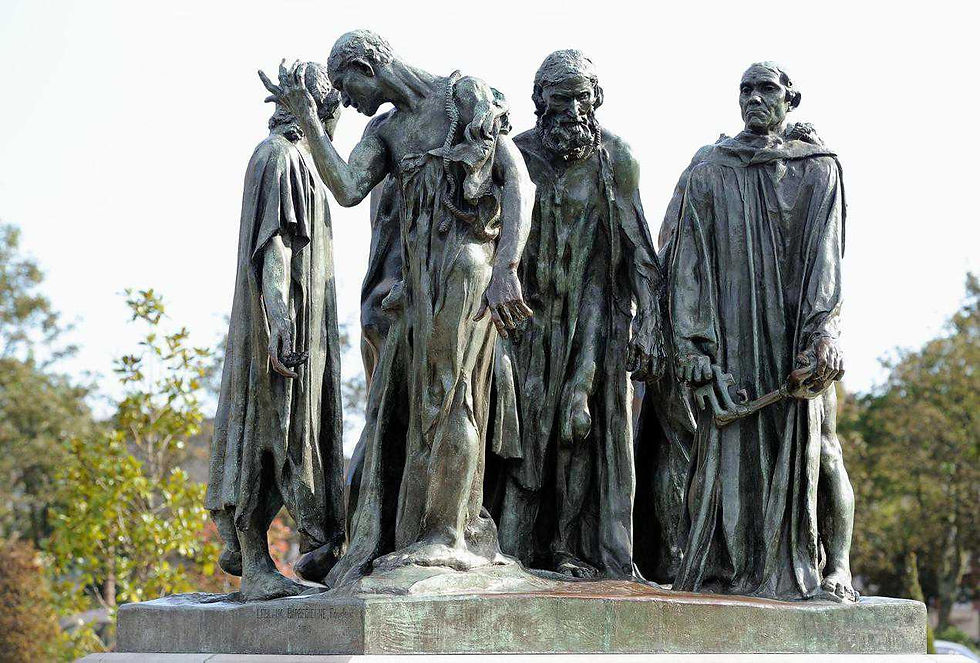
With The Burghers of Calais, Auguste Rodin no longer glorifies idealized heroes. He reveals the dignity, doubt, and humanity of men confronted with their destiny.
A few years later, The Burghers of Calais confirmed this break.
The commission is awaiting a monument glorifying heroes.
Rodin presents men advancing towards their sacrifice with their doubts, their fear and their resignation.
None dominates the others.
None triumph.
Their greatness stems precisely from their humanity.
Rodin even requested that the statues be installed almost at ground level so that the viewer could encounter them as an equal, without the symbolic distance imposed by a high pedestal.
The hero descends definitively among men.
Rodin's Inner Necessity
Rodin is not seeking to provoke the art world.
He is trying to be sincere.
He can no longer accept a sculpture that represents perfect bodies when life shows him complex, vulnerable and profoundly human beings.
What he wants to sculpt is no longer just a body.
It's a presence.
He wants the bronze to breathe.
Let the stone doubt.
That matter conveys emotion as much as form.
This inner necessity explains his work far more than his style.
The door opened by Rodin
Rodin did not destroy classical sculpture.
It offers him a new freedom.
After him, a sculpture no longer needs to glorify a character to become universal.
It can speak of loneliness, love, fear, fragility, hope, or silence.
This freedom paved the way for all modern sculpture.
Brancusi will seek the essence of forms.
Giacometti will translate the solitude of man.
Henry Moore will turn the body into a landscape.
They will all, in their own way, use the door that Rodin was the first to open.
What Rodin changed
Rodin did not just renew sculpture.
He changed the way people looked at it.
Before him, a statue primarily represented someone.
Since him, she has revealed above all something profoundly human.
By bringing heroes down from their pedestals, Rodin returned sculpture to man.
And this silent revolution continues to inhabit contemporary creation to this day.
By returning sculpture to man, Rodin opened up a new freedom.
One question, however, remains unanswered.
Once the man was found, was it still necessary to faithfully reproduce his appearance?
Constantin Brancusi would dedicate his entire work to this question.
Constantin Brancusi (1876–1957)
He who sought essence rather than appearance

With Bird in Space, Constantin Brancusi no longer represents a bird. He seeks to reveal the essence of flight, opening a new path towards abstraction in sculpture.
Brancusi: Is it still necessary to copy reality?
Rodin had restored sculpture to man.
A new question now arose.
Was it still necessary to faithfully reproduce its appearance?
For Constantin Brancusi, the answer is no.
He deeply admired Rodin, but quickly understood that he could never go further by following in his footsteps. He would later summarize this conviction with a now-famous phrase:
"Nothing grows in the shade of large trees."
This is not a rejection of Rodin.
It is the awareness that a new door must now be opened.
Seeing beyond what the eye sees
Since antiquity, sculpture has sought to reproduce the visible world with ever greater precision. Even Rodin, despite his revolution, remained deeply attached to the human body, its tensions, its energy, and its presence.
Brancusi believes that this fidelity to appearances can become a limitation.
For him, copying nature is no longer enough.
Art's mission is not to reproduce reality.
He must reveal what lies behind him.
The sculptor's role is no longer to imitate forms.
It is about discovering the truth.
Remove to reveal
Contrary to what is often claimed, Brancusi did not simplify his sculptures out of a taste for abstraction.
He gradually removes everything that seems unnecessary to him.
Each detail removed brings the work closer to its essence.
His gesture is not a reduction.
It's a purge.
He seeks the most accurate form, the one that expresses an idea without needing to describe it.
For Brancusi, simplicity is never easy.
It is the culmination of a long search.
When form becomes an idea

Constantin Brancusi's sculpted head "The Sleeping Muse," a modern bronze sculpture illustrating the simplification of forms
and the birth of a sculpture where form becomes an idea.
This approach appears with The Kiss.
Two beings embracing become almost a single unit.
Faces, hands, and bodies lose their detail.
The emotion, however, becomes stronger.
Brancusi no longer seeks to represent two people.
He seeks to make the union visible.
A few years later, with Bird in Space, this quest reached its culmination.
At first glance, the sculpture hardly resembles a bird anymore.
There are no wings, no feathers, no beak.
And yet, everyone immediately perceives the momentum, the lightness, and the movement.
Brancusi no longer sculpts birds.
He sculpts flight.
An almost spiritual quest
For Brancusi, each sculpture is an inner quest.
He tirelessly polishes the stone, marble or bronze until he obtains a surface where the light seems to be part of the work.
Matter ceases to be mere matter.
She becomes light, silence, and presence.
This research goes beyond technique.
It's almost spiritual in nature.
Brancusi does not seek to impress the eye.
He seeks to reach a truth deeper than resemblance.
He does not ask the viewer to recognize a subject.
He invites her to feel a presence.
The door opened by Brancusi
With Brancusi, sculpture discovered that it could express an idea without faithfully reproducing the visible world.
This freedom is immense.
Thanks to him, a work can become more real by showing less.
Emotion no longer depends on the quantity of details.
It arises from the accuracy of the form.
This revolution paved the way for a whole generation of sculptors.
Henry Moore, Barbara Hepworth, Isamu Noguchi and many other artists understood that simplification does not impoverish sculpture.
On the contrary, it allows it to reach a universal dimension.
What Brancusi changed
Rodin had restored sculpture to man.
Brancusi frees her from appearance.
From this point on, a sculpture no longer needs to faithfully reproduce reality to express a truth.
It can evoke an idea, a movement, an emotion or a presence with a few essential lines.
By opening this second door, Brancusi demonstrates that the power of a work does not reside in what it shows, but in what it reveals.
By seeking essence rather than appearance, Brancusi demonstrates that sculpture no longer needs to imitate reality to express a truth.
Another question then arises.
If a work is no longer defined by its resemblance, is it still defined by its fabrication?
Marcel Duchamp would overturn this certainty.
Marcel Duchamp (1887–1968)
The one who brought the idea into sculpture

Marcel Duchamp, Bicycle Wheel (1913). With ready-mades, Duchamp shifts the question of art: it is no longer just the material or the know-how that defines a work, but the artist's gaze and the idea he proposes.
Duchamp: What makes a work of art?
Rodin had placed man back at the heart of sculpture.
Brancusi had shown that essence mattered more than appearance.
A new question was now about to revolutionize the entire art world.
Must a sculpture still be defined by the material it is made of?
For Marcel Duchamp, the answer is no.
For centuries, a sculpture has been admired for the quality of its execution, the mastery of the gesture and the work with the material.
Duchamp challenges this obvious truth.
According to him, what makes a work of art is not just what we see.
This is also the idea that gives it meaning.
By opening this third door, he profoundly transforms our way of understanding sculpture.
When thought becomes a material
For centuries, sculpture has been inseparable from the artist's gesture.
To cut, shape, sculpt, polish...
Creation seems to originate exclusively from the hand.
Duchamp shifts the center of gravity.
For him, the work begins well before the working of the material.
It is born from an intention.
The idea no longer accompanies the sculpture.
It becomes one of its materials.
This statement seems simple.
Yet it is one of the greatest revolutions in modern art.
Choosing becomes an act of creation
With Bicycle Wheel, then Fountain, Duchamp made a radical gesture.
He no longer seeks to demonstrate his technical skill.
He chooses an ordinary object and presents it as a work of art.
The true creative act is no longer about making things.
It's about looking at things differently.
The object hardly changes.
Our perspective, however, changes completely.
Sculpture is no longer limited to transforming matter.
It can transform an idea.
A work that raises questions

Marcel Duchamp, Bottle Rack (1914). By choosing a manufactured object without transforming it, Duchamp affirms that the work of art no longer resides solely in its fabrication, but also in the idea and the gaze of the artist.
Until then, sculpture primarily sought to show.
Duchamp also asks him to ask questions.
Why does this object become a work of art?
Who decides what belongs to art?
Is beauty an essential condition?
Is technical virtuosity enough to create a work of art?
These questions become an integral part of the creative process.
The viewer is no longer simply invited to contemplate.
He becomes an active participant in the discussion.
A revolution that is often misunderstood
Duchamp has sometimes been portrayed as someone who wanted to destroy art.
That's a reductive interpretation.
His ambition is not to deny sculpture.
Its aim is to broaden its definition.
He does not replace matter with ideas.
It shows that the idea itself can become a material for creation.
From him onwards, sculpture is no longer confined to a single way of existing.
The door opened by Duchamp
By placing thought at the heart of the work, Duchamp opens up a new territory.
Sculpture is no longer simply a fashioned object.
It also becomes a proposition, an experiment, a question.
This freedom does not replace traditional forms.
She joins them.
Now, the sculptor can choose to work with stone, bronze, wood… or an idea.
None of these paths cancels out the others.
They coexist.
And it is this coexistence that profoundly marks contemporary sculpture.
What Duchamp changed
Rodin had changed the subject of the sculpture.
Brancusi had changed his language.
Duchamp changes his definition.
After him, a work is no longer judged solely on the quality of its execution.
It is also significant because of the strength of the question it poses.
Sculpture ceases to be merely an object to be looked at.
It also becomes a way of thinking about the world.
A new door opens
With Rodin, sculpture had rediscovered man.
With Brancusi, she had sought her essence.
With Duchamp, she discovers that no rule is now immutable.
This freedom does not lead all artists in the same direction.
On the contrary.
It opens up an almost infinite field of exploration.
Among those who will invest in it, Alberto Giacometti will take a very personal path.
His question is no longer about what a sculpture is.
It is about understanding how a sculpture can make visible the fragility of human existence.
It is this fourth door that he will open.
Alberto Giacometti (1901–1966)
He who sculpted the human condition

Alberto Giacometti, Walking Man I (1960). Following the revolutions of Rodin, Brancusi, and Duchamp, Giacometti refocused sculpture on the human being. His fragile and slender figures express less a body than a presence, a solitude, and a universal human condition.
Giacometti: How to show the human presence?
Rodin had restored sculpture to man.
Brancusi had been searching for his essence.
Duchamp had demonstrated that an idea could become a work of art.
A new question then arises.
How can a sculpture make visible what it means to be a man?
For Alberto Giacometti, this questioning guided a lifetime of creation.
He no longer seeks to represent a famous person, a perfect body, or an ideal form.
He is trying to grasp something almost ungraspable.
Human presence.
Sculpting what cannot be seen
When we meet a person, we don't just perceive their face or body.
We also feel his presence.
Its fragility.
His solitude.
Its existence.
Giacometti understood that it was precisely this invisible reality that sculpture had never truly succeeded in showing.
Based on this observation, his work changed radically.
He no longer seeks to faithfully reproduce a man.
He seeks to make perceptible what he feels in front of him.
Sculpture then ceases to be an imitation.
It becomes an experience.
Reduce to approach the truth
Over the years, his figures have become increasingly refined.
Their flesh seems to disappear.
Their silhouettes stretch to the extreme.
Many see it as an aesthetic pursuit.
In reality, Giacometti was pursuing a completely different ambition.
He gradually removes everything that seems unnecessary to him, keeping only the essential: presence.
His sculptures appear fragile.
Yet they give an impression of exceptional inner strength.
As if, despite their extreme vulnerability, they relentlessly continued to move forward.
The Walking Man

Alberto Giacometti, The Square (1948). Several figures cross paths without ever meeting. The sculpture no longer tells a story: it gives form to human experience, to the distance between beings, and to the feeling of existence.
In 1960, Giacometti created Walking Man, which became one of the most famous sculptures of the 20th century.
Why does it work?
We don't know.
Where is he going?
Never mind.
What matters is not its destination.
It's the fact that he's moving forward.
This slender silhouette becomes a universal metaphor for the human condition.
We are all moving forward.
With our doubts.
Our wounds.
Our hopes.
Our uncertainties.
The walking man represents no one.
And that is precisely why he speaks to everyone.
A work that looks at the viewer
Giacometti's sculptures do not seek to impress.
They celebrate neither power nor grandeur.
They impose silence.
When faced with them, the visitor finds themselves slowing down.
To be observed differently.
To feel more than to analyze.
The work does not tell a story.
It brings about a meeting.
Perhaps this is Giacometti's true revolution.
Sculpture no longer simply shows something.
It reflects us back to ourselves.
The door opened by Giacometti
With Giacometti, sculpture becomes a means of exploring human existence.
She is no longer solely seeking beauty, harmony, or innovation.
It becomes a language capable of evoking solitude, time, fragility, waiting, or perseverance.
This approach would profoundly influence many artists.
No, because they will imitate his silhouettes.
But because they will understand that sculpture can express invisible realities, emotions and human experiences that go beyond simple representation.
What Giacometti changed
Rodin had given a soul to the body.
Brancusi had sought the soul of form.
Duchamp had liberated thought.
Giacometti gives form to existence.
After him, a sculpture is no longer just an object, a material or an idea.
It can become the visible trace of our presence in the world.
It reminds us that sculpture is not only meant to be looked at.
It is also meant to be felt.
A new question arises.
If sculpture can reveal the human condition, can it also transform our relationship to the space around us?
This question opens up a new avenue.
Henry Moore will no longer observe only the human figure.
He will explore the relationship between matter, emptiness, and landscape.
With him, sculpture will cease to occupy a space.
She will begin to talk to him.
Henry Moore (1898–1986)
The one who brought space into sculpture

Henry Moore, Reclining Figure. Henry Moore transforms the human figure into a landscape of curves and voids. The sculpture no longer represents simply a body: it engages in a dialogue with light, space, and nature.
Henry Moore: Where does a sculpture begin and end?
Rodin had restored sculpture to man.
Brancusi had been searching for his essence.
Duchamp had incorporated the idea into the work.
Giacometti had sculpted the human condition.
A new question then arises.
Does a sculpture exist solely because of the material it is made of?
For Henry Moore, the answer is no.
A sculpture is not limited to its outlines.
It interacts with the space around it.
Emptiness, light, landscape, and the viewer's gaze also become elements of the creation.
With Moore, sculpture ceases to occupy a place.
She begins to live with him.
When emptiness becomes matter
For centuries, sculpture was primarily a volume.
It commands attention through its mass, its weight, and its presence.
The void is simply what surrounds it.
Henry Moore reverses this way of seeing things.
For him, emptiness is not an absence.
It is part of the work.
An opening in a sculpture is not a deficiency.
It allows light to circulate, the landscape to enter the work, and the gaze to pass through it.
Space becomes a true material.
Invisible.
But indispensable.
A sculpture that you discover while walking
Moore's works never reveal their secrets at a single glance.
We need to move around them.
Approach.
Move away.
Observe the light gliding over their curves.
Watching the sky appear through an opening.
With each move, the sculpture changes.
What was thought to be massive becomes light.
What we thought was full reveals an emptiness.
The viewer no longer simply contemplates a work of art.
He enters into a dialogue with her.
The landscape as a partner

Henry Moore, Large Two Forms (1966-1969). Two sculpted masses seem to respond to each other without ever touching. With Moore, emptiness becomes as important as matter, making space an essential element of sculpture.
Henry Moore often prefers to exhibit his sculptures outdoors.
This choice is not insignificant.
The sky, the trees, the grass, the clouds or the seasons all contribute to the perception of the work.
A sculpture is never exactly the same depending on the morning light, the rain or the setting sun.
The landscape no longer serves as a backdrop.
He becomes a partner.
The boundary between the artwork and its environment gradually disappears.
The human figure reinvented
Moore's forms often evoke the human body.
But they never try to reproduce it faithfully.
They suggest more than they describe.
A shoulder becomes a hill.
A hip resembles a pebble polished by the sea.
A torso appears to have been shaped by the wind.
Nature and the human body now speak the same language.
Moore does not copy reality.
It reveals the deep links that unite man with his environment.
The door opened by Henry Moore
With Henry Moore, sculpture ceased to be an isolated object.
It becomes a permanent dialogue between matter, emptiness, light, landscape and the one who looks at it.
This vision would permanently transform 20th-century monumental sculpture.
Many artists will then understand that a work is not limited to what it shows.
She also understands everything around her.
Space is no longer just a backdrop.
It becomes part of the sculpture.
What Henry Moore changed
Rodin had changed our view of man.
Brancusi in form.
Duchamp on the definition of the work.
Giacometti on the human condition.
Henry Moore changes our perspective on space.
After him, a sculpture can no longer be conceived independently of the place where it is located.
Emptiness is no longer an absence.
He becomes a presence.
The landscape is no longer a setting.
He becomes a partner.
The sculpture breathes.
A new door opens
If sculpture can interact with space, can it also transform the way we live together?
This new question will lead some artists even further.
Joseph Beuys will no longer seek only to shape matter.
He will make creation an act capable of acting on society itself.
With him, the sculpture will definitively leave its pedestal.
She will enter into life.
Joseph Beuys (1921–1986)
The one who turned society into a sculpture

Joseph Beuys, The Sliding Table (1969). Ordinary objects become carriers of memory and symbols. For Beuys, sculpture is no longer just a form: it conveys an experience, a story, and an idea.
Beuys: Can sculpture transform society?
Rodin had placed man back at the heart of sculpture.
Brancusi had sought its essence.
Duchamp had demonstrated that an idea could become a work of art.
Giacometti had explored the human condition.
Henry Moore had brought space into sculpture.
A new question then arises.
Can sculpture transform anything other than matter?
For Joseph Beuys, the answer is a resounding yes.
According to him, sculpture is no longer limited to a form, a material or an object.
It can become a force capable of transforming men, their relationships and, ultimately, society itself.
The creative process doesn't stop in the studio.
For centuries, the sculptor has created a work intended to be looked at.
Even when it surprises or raises questions, it remains an object.
Beuys takes another step forward.
He believes that the act of creating can transcend the work itself.
A conference.
A discussion.
A collective action.
A tree plantation.
A civic commitment.
All of this can be part of the same creative process.
Art is gradually leaving its pedestal.
He enters life.
Every human being possesses a creative power
One of Joseph Beuys' most revolutionary ideas can be summed up in a few words:
" Every man is an artist. "
This sentence is often misunderstood.
Beuys does not claim that everyone is a painter or sculptor.
He asserts that every human being possesses a capacity for creation.
Creating is not just producing a work of art.
It is about imagining, inventing, transmitting, building, and changing the world around us.
Creativity becomes a responsibility.
As much as a freedom.
Social sculpture

Joseph Beuys, 7000 Oaks (1982). With this monumental project, Beuys expanded sculpture to a societal scale. Planting trees became an artistic act: the transformation of the world was now part of the artwork.
It was this conviction that led Beuys to develop an entirely new idea: social sculpture.
For him, a society is like a substance in perpetual transformation.
Every decision, every exchange, every collective project contributes to giving it shape.
The true work of art is no longer just that which occupies a museum.
It can be a school, a city, a public debate, or a joint action.
Art does not disappear.
It changes scale.
When a forest becomes a work of art
In 1982, Joseph Beuys launched a project entitled 7000 Oaks.
His goal is to plant seven thousand trees, each accompanied by a basalt stone, in order to permanently transform the urban landscape of the city of Kassel.
The work is not only made up of trees.
It also resides in time, in the participation of the inhabitants and in the changes it produces over the years.
Sculpture ceases to be a static object.
It becomes a living process.
A revolution bigger than matter
Felt, grease, copper, and honey occupy an important place in Beuys' work.
But they are never an end in themselves.
They serve as the basis for a broader reflection.
Its true raw material is human energy.
The ideas.
The exchanges.
The ability of women and men to build a different future together.
That is where its true revolution lies.
The door opened by Joseph Beuys
With Joseph Beuys, sculpture definitively ceased to be limited to the object.
It becomes a way of acting on reality.
It can raise awareness, create connections, transform a territory, or give rise to new ways of thinking.
A work is no longer measured solely by its form.
It is also measured by what it sets in motion.
What Joseph Beuys changed
Rodin had changed the way we looked at man.
Brancusi in form.
Duchamp on the definition of the work.
Giacometti on the human condition.
Henry Moore on space.
Joseph Beuys changed the very role of sculpture.
After him, creating no longer consists solely of shaping matter.
Creating can also mean transforming human relationships, ideas, and society.
Sculpture becomes a living force.
A freedom with a thousand paths
After Joseph Beuys, sculpture no longer followed a single direction.
She explores a multitude of territories.
Some artists will incorporate movement into their works.
Others will transform everyday objects into monuments.
Others will play with perception, emptiness, light, or the immensity of spaces.
All these approaches are different.
But they share the same heritage.
The belief that sculpture has become a territory of freedom where each artist can pose their own question to the world.
The New Territories of Sculpture
The artists just mentioned have profoundly transformed our way of thinking about sculpture.
Thanks to them, it is no longer confined to a single definition.
It has become a territory of freedom.
Future generations will no longer have to redefine sculpture.
They will now be able to explore the many paths it offers them.
Some will incorporate the movement into their works.
Others will magnify everyday objects.
Others will play with perception, memory, landscape, or industrial materials.
All these approaches are different.
But they bear witness to the same freedom: that of posing, through sculpture, a new question about the world.
The great revolutions in sculpture did not end its history. They opened up vast territories that other artists would explore. Claes Oldenburg was one of the first to venture into the realm of the monumental everyday.
Claes Oldenburg (1929-2022)
The one who brought the everyday into the monumental

Claes Oldenburg, Clothespin (1976). By enlarging a commonplace object to a monumental scale, Oldenburg transforms our view of the everyday. Sculpture now arises from humor, changes of scale, and surprise.
A new freedom
When Joseph Beuys asserted that everything could become material for creation, sculpture definitively broke free from its traditional limits. It was no longer defined by marble, bronze, or stone. It became a way of thinking about the world.
This freedom opens up an unexpected territory.
If everything can become sculpture, why should the most ordinary objects be excluded from art?
Why couldn't a clothespin, an ice cream cone, a hamburger, or a spoon tell the story of our time with as much power as a statue of a king or a general?
This is the question that Claes Oldenburg will explore.
Not by repurposing everyday objects, but by giving them a place they had never occupied: that of a monument.
The everyday changes scale
For centuries, the monumental was reserved for great figures, military victories, heroes, or religious beliefs.
Oldenburg completely reverses this logic.
He chooses objects that everyone knows, precisely because no one looks at them anymore.
A simple clothespin becomes a sculpture several meters high.
A giant spoon cradles a gigantic cherry in the middle of a park.
A lipstick emerges in the public space like a piece of architecture.
By changing their scale, Oldenburg transforms our perception.
These objects cease to be utilitarian.
They become presences.
They attract our attention in the same way that monuments once did.
The works that make this idea visible
Clothespin , installed in Philadelphia, seems almost to be in dialogue with the buildings that surround it. The domestic object becomes an urban landmark. The passerby doesn't just discover a monumental sculpture; they rediscover an object they thought they had always known.
With Spoonbridge and Cherry , the spoon ceases to be a mere utensil. Enlarged to a spectacular scale, it becomes a landscape. The famous cherry resting on its end adds a playful and poetic dimension that contrasts with the monumentality of the whole.
Oldenburg then multiplies everyday objects: ice creams, electrical outlets, typewriters, hamburgers, lipsticks, or tools. They all obey the same logic. It is not the objects that change; it is our perception of them.
What Oldenburg made possible

Claes Oldenburg and Coosje van Bruggen, Spoonbridge and Cherry (1985-1988). The most ordinary objects become monuments. With Oldenburg, sculpture borrows from Pop Art and brings popular culture into the public sphere.
Oldenburg did not redefine sculpture in the same way that Rodin, Duchamp, or Beuys did.
On the other hand, it opens up an entirely new territory.
It shows that monumentality is no longer reserved for heroes.
It can celebrate ordinary life.
It can reveal the poetry of the simplest objects.
It can transform our everyday environment into an aesthetic experience.
Since Oldenburg, monumental sculpture has no longer been merely a tribute to the past.
It also becomes a way of observing the present.
Alexander Calder (1898-1976)
He who made movement a material of sculpture

Alexander Calder, Lobster Trap and Fish Tail (1939). With his mobiles, Calder introduced real movement into sculpture. The work no longer possesses a single form: it constantly changes with the air and the viewer's gaze.
The artists of Les Grandes Portes have progressively liberated sculpture from its oldest constraints. It is no longer merely an imitation of reality, a block of matter, or a frozen monument. It can now become an idea, an experience, a dialogue with space, or even a social act.
One question, however, has remained almost unchanged for millennia.
Must a sculpture necessarily be immobile?
This is the territory that Alexander Calder will explore.
When the sculpture ceases to be immobile
Since antiquity, a sculpture has been conceived as a stable presence.
Even when it represents movement, it remains still.
The bronze doesn't move.
Stone does not breathe.
Marble never changes.
Calder imagined something completely different.
What if sculpture could live with air?
What if the wind, too, became a sculptor?
His works are no longer fixed forms.
They move.
They balance each other out.
They oscillate.
They turn slowly.
Each movement calls for another.
The sculpture ceases to be a definitively finished object.
It becomes a constantly evolving equilibrium.
The works that make this idea visible
Calder's mobiles are among the most recognizable works of 20th-century art.
Composed of metal rods and colorful shapes in balance, they react to the slightest breath of air. No two movements are identical. The artwork constantly creates a new image.
Conversely, his more monumental stabiles appear immobile. Yet, they engage with the landscape through their open lines, voids, and tensions. Even when fixed, they give the impression of suspended movement.
In Calder's work, movement is never a spectacular effect.
It is the very substance of sculpture.
Time enters into the work.
What Calder made possible

Alexander Calder, Flamingo (1974). With his monumental stabiles, Calder delineates space with vast lines of steel. Sculpture no longer simply occupies a place: it engages in a dialogue with architecture, light, and the viewer's movement.
Calder is not seeking to replace traditional sculpture.
It adds a new dimension to it.
After him, a sculpture can change its appearance without ever losing its identity.
It can change over the course of the hours, with the light or the wind.
It is no longer just a shape in space.
It becomes a permanent relationship between matter, time, and the invisible forces that surround it.
A new territory
Calder teaches us that sculpture is not condemned to immobility.
She can breathe.
She may hesitate.
It might surprise you.
She can live.
By introducing real movement into sculpture, he does not overturn its definition like Duchamp or Beuys.
It opens up a territory that countless artists will continue to explore: that of a work that never completely ceases to transform itself.
César (1921-1998)
He who made industry a subject of sculpture

Compression. From the 1960s onwards, César made the hydraulic press his tool of creation. By compressing automobiles or metal objects, he transformed the waste of industrial society into sculptures where the material now tells its own story.
The great revolutions in sculpture gradually freed artists from the materials and forms inherited from tradition.
After Rodin, Brancusi, Duchamp, Giacometti, Moore and Beuys, nothing obliges the sculptor to work with marble or bronze, or even to seek an ideal beauty.
Another question may then arise.
Can the matter produced by our industrial civilization also become sculpture?
This is the territory that Caesar will explore.
When matter tells the story of its time
For centuries, the sculptor has shaped matter.
He's sizing up.
He models.
He polishes.
He seeks to impose his will on the material.
Caesar reverses this relationship.
He discovers that matter already possesses its own history.
A crumpled body.
Pieces of metal.
Abandoned objects.
Industrial waste.
Everything bears the memory of a world in perpetual transformation.
His action is no longer solely that of building.
He reveals.
It transforms without erasing.
It accepts accidents, creases, tears, and mechanical stresses.
The violence of compression becomes a form of writing.
The works that make this idea visible
The Compressions remain his most iconic gesture.
Under the power of a hydraulic press, entire automobiles become blocks of metal of striking density.
The vehicle disappears.
Yet, his story remains legible.
The colours, the fragments of doors, the chips of paint still tell the story of the original object.
Destruction becomes creation.
Conversely, the Expansions seem to follow the opposite trend.
Polyurethane foam spreads freely before solidifying.
This time, the sculptor no longer has total control over the form.
It accompanies a living material that invents its own volume.
Between compression and expansion, Caesar explores two opposing forces.
The constraint.
And freedom.
Ce que César a rendu possible

César, The Thumb (1965). By enlarging a part of the human body to a monumental scale, César transforms an anatomical detail into a universal symbol. Sculpture now plays with change of scale as much as with the material itself.
César shows that sculpture is no longer obliged to transform a noble material to become a work of art.
It can reveal the hidden beauty of the most ordinary materials.
She may still bear the scars of their existence.
She can accept the accident as a form of language.
After him, industrial materials ceased to be mere recycled objects.
They become witnesses to an era.
The industrial footprint
Caesar teaches us that sculpture is not just about making a form.
It can also reveal the invisible forces that act upon matter.
Compression.
Expansion.
Deformation.
Resistance.
All these phenomena become means of expression.
By bringing industry into the workshop, César celebrates neither the machine nor the technology.
It simply shows that our civilization leaves its mark even in the materials it produces.
And that this imprint can, in turn, become a sculpture.
Richard Serra (1938-2024)
He who made the body the measure of sculpture

Richard Serra, “The Matter of Time”, a set of monumental Corten steel sculptures creating an immersive journey where the visitor traverses curved volumes.
The great revolutions in sculpture have gradually freed the artist from representation, from traditional materials, and even from the classical definition of the work.
The explorers who followed them then discovered unexpected territories.
Richard Serra opens one that profoundly transforms our way of encountering a sculpture.
Is a sculpture merely an object to be looked at... or can it become a space to be inhabited?
When the viewer enters the sculpture
For centuries, the visitor stands before a sculpture.
He observes it.
He circles around it.
He admires its shape.
At Serra, this relationship changes completely.
Sculpture is no longer simply something to be contemplated.
It forces you to walk.
To slow down.
To be avoided.
To cross.
To feel one's own body moving in space.
The spectator ceases to be an observer.
He becomes a participant.
The works that make this idea visible
Richard Serra's immense Corten steel plates impress first and foremost by their scale.
Their height often exceeds that of a house.
Their thickness and weight seem almost unreal.
But their true strength does not lie in their size.
It lies in what they provoke.
In works like The Matter of Time, at the Guggenheim Museum in Bilbao , the immense curved walls create passages that narrow and then widen. As one moves forward, perspectives change, sounds alter, and the body's balance is sometimes slightly disturbed.
Each step transforms the work.
No, because it moves.
But because it is we who change.
In Serra's work, sculpture never imposes a single point of view.
It reveals itself as it walks.
What Serra made possible

Richard Serra, Torqued Ellipse IV (1998). The steel walls distort the perception of space and force the visitor to reinvent their path. In Serra's work, sculpture becomes an architecture of sensations.
Richard Serra shows that sculpture can be a physical experience before it is an image.
It is no longer simply a volume placed in a location.
It becomes a place in itself.
The gap between the steel plates is as important as the steel itself.
Distances.
The curves.
The passages.
The sensations.
Everything contributes to the work.
After Serra, many artists conceived their sculptures as spaces to be explored rather than as objects to be contemplated.
Entering the sculpture
Serra teaches us that sculpture is not limited to what we see.
It engages the whole body.
The walk.
Balance.
Orientation.
The perception of light.
Acoustics.
The ratio to scale.
It becomes a lived experience.
By making movement an integral part of the work, Richard Serra opens up a territory where sculpture ceases to be a simple object and becomes an environment.
And perhaps that is his greatest contribution: to have shown that the true material of sculpture is not only steel.
It is also the body of the one who passes through it.
Anish Kapoor (né en 1954)
Emptiness becomes an experience of perception

Anish Kapoor, Cloud Gate (2004-2006). By reflecting the landscape and the visitors, the sculpture no longer shows just a form: it transforms the perception of space and makes the viewer a part of the work.
The great revolutions in sculpture gradually freed artists from representation, traditional materials, and the limitations of the sculpted object.
The explorers who succeeded them no longer sought to define what sculpture is.
They are trying to understand what she can still make us feel.
Anish Kapoor then opens up a fascinating territory.
Can a sculpture give form to that which cannot be grasped or touched?
When emptiness becomes a presence
Sculptors have always worked with materials.
He's sizing up.
He adds.
He withdraws.
But the material remains at the center of his work.
Kapoor shifts this obvious point.
What interests him is no longer just what is present.
That's also what seems to be missing.
The void.
The invisible.
Depth.
The reflection.
Infinity.
In his work, sculpture does not always show a form.
It creates an experience.
The viewer hesitates.
Is what he sees a cavity?
A surface area?
A mirror?
An opening?
His gaze was doubtful.
And it is precisely this doubt that becomes the work.
The works that make this idea visible
With Cloud Gate , installed in Chicago, Kapoor transforms a massive polished steel sculpture into a living mirror. The city, the sky, and passersby are constantly reflected in it. The sculpture is never exactly the same, as it depends on the viewer and the surrounding world.
In his works with deep pigments, the cavities seem to absorb all light. Some appear to open onto a bottomless space. The viewer no longer knows whether what they are observing is a sculpted surface or an infinite depth.
Other creations play with concavities, reflections, or invisible volumes. Kapoor does not seek to deceive the eye; he invites it to accept that perception may remain uncertain.
What Kapoor made possible

Anish Kapoor, Descension (2014). With this hypnotic work, Kapoor transforms emptiness into a presence. Sculpture is no longer limited to matter: it explores perception, infinity, and mystery.
Kapoor shows that sculpture no longer needs to impose a clearly identifiable form.
It may raise a question.
A feeling.
A feeling of dizziness.
She makes it clear that perception is never completely objective.
Each viewer constructs their own experience of the work.
After Kapoor, sculpture became as much an inner experience as a material object.
The work is in the gaze
Kapoor teaches us that sculpture can reveal what escapes the eye.
Emptiness is no longer an absence.
He becomes a presence.
The mirror is no longer just a reflective surface.
It becomes a space where the viewer encounters their own image and the world around them.
By making perception itself the subject of his work, Anish Kapoor opens up a territory where sculpture no longer seeks solely to show.
She seeks to evoke feelings.
Louise Bourgeois (1911-2010)
Memory becomes a material to be sculpted.

Louise Bourgeois, Maman (1999). The spider, both protective and unsettling, becomes the symbol of the mother. With Bourgeois, sculpture gives form to emotions, memories, and intimate wounds.
The great pioneers of modern sculpture freed artists from the constraints of representation, traditional materials, and imposed forms.
The explorers who followed them then discovered that this freedom could be exercised in another direction.
No longer just towards the visible world.
But towards the inner world.
Louise Bourgeois opens this territory with a profoundly human question.
Can a sculpture give form to our memories, our wounds, and our most intimate emotions?
When the work becomes a memory
For a long time, sculpture has told stories of heroes, gods, events, or ideals.
She looks outside.
Louise Bourgeois does exactly the opposite.
She looks within herself.
Her work draws on childhood memories, family relationships, fears, absences, wounds, and the bonds that build a life.
For her, sculpture's mission is not to faithfully represent reality.
It makes visible emotions that words sometimes struggle to express.
Each work becomes an attempt to understand what shapes us.
The works that make this idea visible
The enormous spiders in the Maman series are undoubtedly Louise Bourgeois' most famous works.
At first glance, they impress with their size.
They could even inspire fear.
However, the artist gives them a completely different meaning.
The spider represents his mother.
Patient.
Protective.
Weaver.
Fragile and strong at the same time.
A disturbing image suddenly becomes a figure of tenderness.
With his Cells, Bourgeois creates small enclosed spaces composed of doors, wire mesh, furniture, clothing or familiar objects.
The visitor does not simply enter a facility.
He enters a fragment of memory.
Each element seems to carry a story, without ever telling it completely.
The work leaves essential room for the imagination and personal experience of the person who discovers it.
What Bourgeois made possible

Louise Bourgeois, Cell (Eyes and Mirrors) (1989-1993). The "Cells" do not represent a real place, but a mental space. Objects, mirrors, and memories compose a sculpture where inner experience becomes the true subject of the work.
Louise Bourgeois shows that sculpture can become a language of intimacy.
She no longer needs to recount a historical event or celebrate a character.
It can explore universal emotions.
Fear.
Protection.
Love.
Loneliness.
The loss.
By transforming her own memories into sculpted forms, she allows everyone to recognize a part of their own story.
Antony Gormley (born 1950)
The human body becomes a universal landmark
A new freedom
The artists who came before Antony Gormley opened up ever wider territories.
The everyday.
Movement.
Matter.
Space.
Perception.
Memory.
Yet one question remains essential.
How can one represent the human being without telling the story of a particular individual?
This is the territory Antony Gormley set out to explore.
When the body stops being a portrait
For centuries, sculpture represented people.
Sovereigns.
Heroes.
Saints.
Models.
Even as it became modern, it often retained a precise identity.
Gormley chose a different path.
His sculptures don't seek to tell someone's story.
They seek to represent each and every one of us.
The body becomes a presence.
A silhouette.
A volume.
A meeting point between the individual and the universe.
This is no longer a portrait.
This is the human condition.
Works that make this idea visible
Another Place, installed on a beach near Liverpool, lines up a hundred figures facing the horizon.
At low tide, they seem to wait.
At high tide, some nearly vanish beneath the water.
The landscape becomes part of the work.
So does time.
But above all, these anonymous silhouettes invite each of us to project ourselves into them.
What are they looking at?
What are they searching for?
They offer no answers.
They open a reflection.
With Angel of the North, an immense steel figure standing in the north of England, Gormley turns a human silhouette into a monumental landmark. The work evokes neither a historical figure nor a particular belief. It has become a symbol of presence, protection, and belonging to a place.
In many other installations, hundreds of figures occupy buildings, rooftops, or landscapes. They appear silent, motionless, but never inert.
They simply remind us that man is part of the world.
What Gormley made possible
Gormley shows that sculpture can speak of all human beings without representing any one in particular.
It no longer needs a recognizable face.
Nor a narrative.
Nor an identity.
The body becomes a universal language.
A simple form capable of holding each person's own questions.
After him, many artists would come to see the human figure not as a character, but as a presence.
Antony Gormley teaches us that sculpture can bring us back to the essential.
Being there.
Inhabiting a place.
Sharing a space with others.
Looking at the horizon.
Breathing.
His works do not seek to impress.
They invite silence.
Contemplation.
A quiet awareness of our place in the world.
By making the human body a universal landmark, Gormley opens a territory where sculpture no longer simply represents man.
It invites us to experience our own existence.
Having explored the body, space, matter, memory, and human presence, one last frontier remains. Not what man shows, but what he carries within. It is toward this inner world that Jaume Plensa opens the final door of our journey.
Jaume Plensa (born 1955)
Silence becomes a presence
A new freedom
Since Rodin, sculpture has never stopped widening its horizon.
It rediscovered man.
Searched for essence.
Found the power of ideas.
Learned to converse with space.
Transformed society.
Explored the everyday, movement, matter, perception, memory, and human presence.
One last question remains.
Can sculpture give form to what cannot be seen — silence, thought, consciousness?
This is the territory Jaume Plensa explores.
When sculpture becomes a place of meditation
For a long time, sculpture sought to show.
A body.
A face.
An event.
An emotion.
For Plensa, showing is no longer enough.
He seeks to create an inner space.
His large figures, eyes closed, express neither joy, nor sadness, nor anger.
They simply seem inhabited by silence.
The viewer no longer just looks at a sculpture.
They slow down.
They listen.
They let themselves be overtaken by a kind of calm.
The work doesn't speak louder.
It speaks deeper.
Works that make this idea visible
The immense faces of young women, eyes closed, have become emblematic of Jaume Plensa.
Their features are peaceful.
Their scale is monumental.
And yet, nothing overwhelms the visitor.
Quite the opposite.
Their serenity seems to calm the space around them.
In other works, human silhouettes are made up of letters drawn from many different alphabets.
These characters don't form sentences.
Instead, they evoke the idea that every culture, every language, and every history belongs to one shared humanity.
For Plensa, words become matter.
Light becomes matter.
Silence itself becomes almost visible.
What Plensa made possible
Plensa shows that sculpture can offer far more than an aesthetic emotion.
It can become a place of contemplation.
A moment of pause in a world saturated with noise and images.
It imposes no message.
It opens a space where each person can find their own reflection.
After him, sculpture appears less as an object to admire than as an inner experience to be lived.
A new territory
Jaume Plensa teaches us that the greatest presence is not always the one that imposes itself.
Sometimes, it is the one that invites silence.
His sculptures seek neither to convince nor to impress.
They welcome.
They slow the gaze.
They create a quiet encounter between the work and the one who contemplates it.
By turning inwardness into a true sculptural experience, Plensa opens a territory where sculpture stops speaking about the world.
It simply invites us to fully inhabit our own humanity.
A conclusion before the conclusion...
And I believe that this is where our entire journey takes on meaning.
At the beginning of this story, Rodin restored a truth to the human body.
In the end, Plensa reminds us that this body also carries an inner world.
Between these two moments, sculpture has continued to expand its language.
It has moved from representation to essence.
From essence to idea.
From idea to space.
From space to society.
Then in everyday life.
To the movement.
To the matter.
To perception.
In memory.
To the presence.
And finally...
To conscience.
It's not a straight line.
This is not a hierarchy.
It is a gradual conquest of new territories.
Each artist does not erase the previous one.
He is simply opening a door that no one had yet crossed.